
Industrial engineer · AI engineer at Spatialedge

Knowledge work is the new factory floor.

I’m Tiaan van Antwerpen. I trained as an industrial engineer: a company is a system of people and processes, and the job is to get the most value out of it. Agentic AI is the same job on a new floor. I find where the work waits, build what relieves it, and measure whether it did.

Tiaan van Antwerpen
Trained as
Industrial engineer
Then
MEng Data Science, cum laude
Thesis
LLM routing for agentic systems
Now
AI engineer, Spatialedge

01 · How I think

Every system has one constraint. Find it before you add AI.

“An hour lost at a bottleneck is an hour lost for the total system.”
Eliyahu M. Goldratt, The Goal

Industrial engineers have measured factories for a century: how long an order takes, how many units leave a shift, what each one costs, how many come back. The theory of constraints adds one hard rule. A system only moves as fast as its slowest step, so improving anything else is an illusion.

Knowledge work is a line too, just harder to see. An agent is a new machine on it. It earns its place only if the whole line moves faster, cheaper or better, and the only way to know is to measure it before and after. That is the part most AI projects skip, and the part my degree is about.

Read the long version: The factory moved into the inbox
fig. 2 · A knowledge-work line, simplified○ operation · □ inspection · → flow
  1. op. 10Intake
  2. op. 20Triage
  3. the constraintinsp. 30Expert review
  4. op. 40Decision
  5. op. 50Action

Work piles up in front of the one step only an expert can do. A faster intake changes nothing. An agent that prepares each case so the expert decides in minutes moves the whole line.

02 · Unpacking myself

Why a backpack?

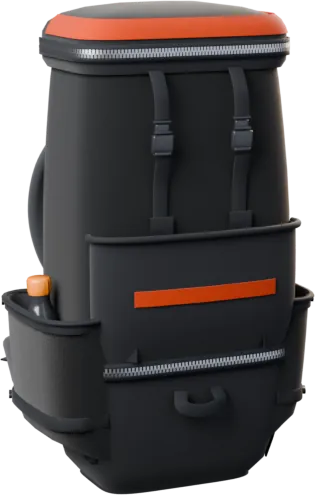
Because most of my weekends end up outside, hiking the Wild Coast and the Western Cape or out on the Atlantic. A pack is the system I know best, so instead of a list, here is mine. Scroll, and it opens one compartment at a time, from what I do for a living down to what carries the load.

A loaded hiking pack, closed
Unpacking myselfWaypoint 01 of 05

01 · The pack

I pack the way I build.

In The Goal, a scout troop on a hike can only move as fast as Herbie, its slowest boy, until someone opens his pack and shares out the load. That is the theory of constraints in one afternoon.

A pack is the clearest system I know: every item earns its place, the heavy things ride against your back, and whatever you need first goes on top. So here is mine, one compartment at a time.

02 · The lid

What I do for a living.

The lid holds what you reach for first. I am an AI engineer at Spatialedge, usually forward-deployed: with the client from the first prototype to the thing running in production.

  • 2024–nowAI & Software Engineer, Spatialedge

    Built the first proof of concept for DataLlume, the company’s enterprise GenAI product, and took it into production at several large corporates. Since then, a claims processing platform for a transport company in the United States and an agentic diagnostic system for a fleet of more than forty thousand vehicles, both forward-deployed with the client.

  • 2022Startup venture evaluation, Blackslope

    Evaluated early-stage ventures through market analysis, value chain assessment and competitor research, and helped shape their initial value propositions.

03 · The side pocket

What I build anyway.

The side pocket is for whatever you want to reach without stopping to take the pack off. Mine is the work nobody asked me to do.

04 · The bottom compartment

What I write down.

The sleeping bag goes in the bottom because you only need it at the end of the day. Writing is the same: it is where the thinking goes once it has settled. Mostly the gap between a model that scores well on a benchmark and a system someone is willing to rely on.

All the writing

05 · The harness

What carries the load.

None of the weight is held by the fabric. It is held by the frame and the harness, and nobody looking at a pack ever sees them. Mine is industrial engineering: seeing people and processes as one system, and measuring where its value leaks.

  • 2024–2025MEng Data Science, Stellenbosch

    Cum laude. My thesis, Adaptive LLM Routing for Effective Agentic Workflows, was done as a case study with Spatialedge and released as an open-source framework.

  • 2020–2023BEng Industrial Engineering, Stellenbosch

    Operations research, mathematical modelling and systems design. My final project built a decision support system that used computer vision to classify pesticide decomposition on leaves.

03 · Contact

Get in touch.

Email is the quickest way to reach me, whether it is about work, a collaboration, or comparing notes on agentic systems.